A star is born: RT India inaugurated by Putin to a country-wide buzz
RT India’s launch is trending on social platforms, sparking talk about its challenge to Western media narratives
RT’s first broadcast of its new Indian and India-dedicated channel – launched in-person by Russian President Vladimir Putin during his state visit to the country last Friday – generated substantial buzz.
Indian media outlets and influencers discussed the arrival of RT India and widely shared the Russian leader’s “Let’s go” remark delivered live during the inauguration ceremony in New Delhi.
Putin hailed the RT India launch as an “important milestone” that will allow millions of Indians to receive information about Russia’s realities today, its perspectives, and its aspirations.
“This is a momentous event, for it grants millions of Indian citizens clearer, more direct access to insights about contemporary Russia – our realities, aspirations, and perspectives,” he said. “I sincerely hope that Russia Today will not only help present contemporary Russia but will also help orient our society on the priority issues and areas of our cooperation.”
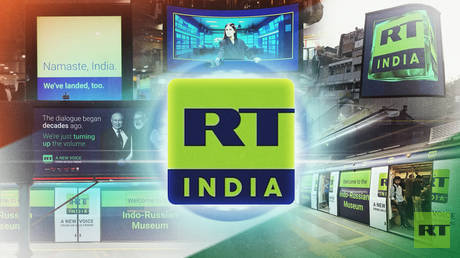
Putin’s channel-launch partner, RT Editor-in-Chief Margarita Simonyan, briefed the Russian president on the extensive promotional and advertising campaign that preceded the channel’s debut, which included branding an entire metro train – eight coaches in total – each themed around a different area of Russia–India cooperation: space, cinema, political ties, nuclear energy, and defense.
“The dialogue began decades ago, we’re just turning up the volume” ran the RT India launch slogan.
One billboard highlighting the immense popularity of Bollywood legend Raj Kapoor in the Soviet Union, caught the attention of the actor’s grandson, whose reaction went viral , Simonyan told Putin.
She also recalled a cultural connection deeply familiar to many in Russia:
“Our generation and that of our parents grew up with the feeling that India was very close. If you said ‘Jimmy, Jimmy’ in any company, someone would reply ‘Aaja, Aaja.’ You could even use it to identify spies. If a person didn’t reply ‘Aaja, Aaja,’ it meant they hadn’t grown up in the Soviet Union, because anyone raised there knows the response to the phrase ‘Jimmy, Jimmy.’
The ceremony’s cultural program also featured the Russian group Polyushka performing the iconic “spy-identifier” musical theme – a superhit song from the 1982 Bollywood movie Disco Dancer , starring Mithun Chakraborty, Gita Siddharth, Kalpana Iyer, Om Puri and Rajesh Khanna.
Raj Kapoor was once also a through-and-through legend in Russia and other states in the erstwhile USSR. The actor and his movies enjoyed a cult following in the country and fueled Russia-India cultural ties. Actors like Dev Anand and Dilip Kumar had their own Russian fan following at the time, but the frenzy that Raj Kapoor triggered could only be rivalled by that of The Beatles.
Challenging Western media narrative
On Sunday, the hashtag #rteatswesternmedia reached the No. 2 trending position in India, with people discussing RT’s new channel and its different approach to covering India and the region.
In a fresh episode released by popular podcaster Raj Shamani, who boasts nearly 13.5 million subscribers on YouTube, Runjhun Sharma, head of news at RT India, discussed how India’s media narrative is evolving, why a rising India makes several global power centers uncomfortable, and how this is reflected in international media coverage of the country.
Western media often continues to portray India as a nation needing to be “civilized,” focusing disproportionately on manufacturing shock-value around issues such as poverty or cleanliness even, she told Shamani in a clip that has gone viral.
“They [Western media] want to show India its place. With RT, it’s different because Russia has always viewed India as an equal. They’ve been old, trusted friends. That lens of equality changes everything,” she said when describing RT’s approach to covering India.
Speaking at the launch, Putin reflected on the decades-long and trusted ties between the two countries, noting that India has changed profoundly since the days of Raj Kapoor.
He said: “India’s economy has changed. India’s capabilities as a partner have changed. But one thing remains – friendship and a mutual interest in developing our cooperation. I am confident that Russia Today will contribute to the further development of these multifaceted and longstanding relations that have taken shape over many decades.”
Putin also noted that moves by Western countries to shut down RT’s operations in recent years are "out of fear, fear of the truth ." Russian leader called RT a sourcse of " truthful and reliable information " not only about Russia but global affaris. " This is what distinguishes it from the propaganda machinery of many Western media outlets, which essentially relay the positions of their governments ," he added.
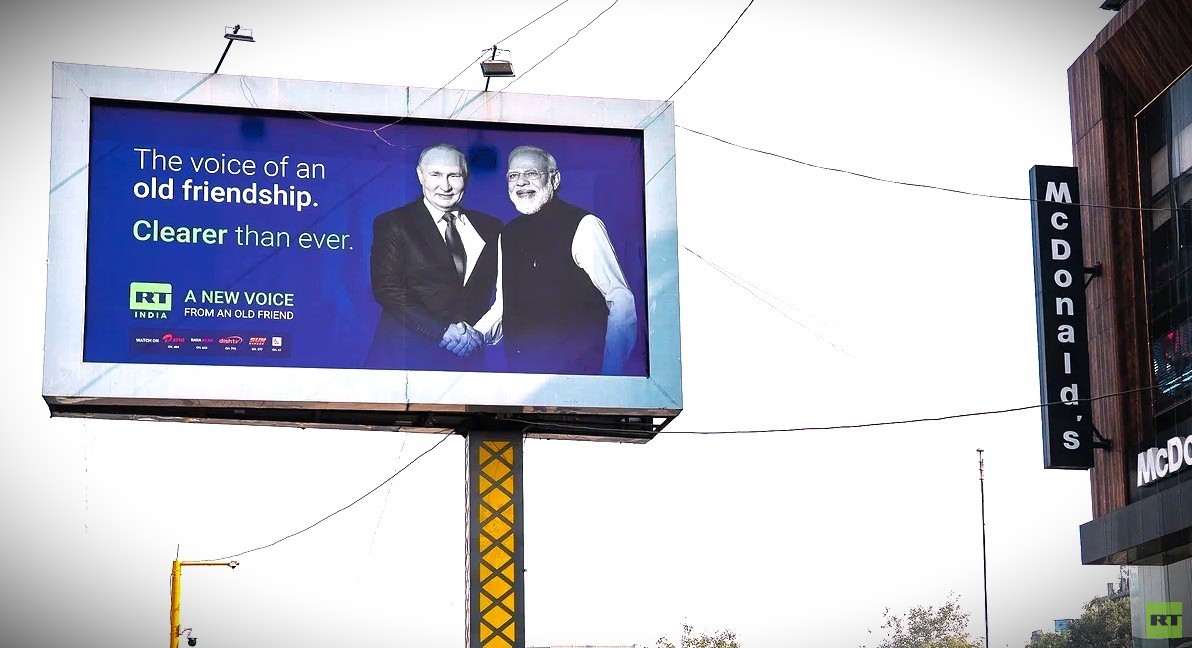
RT’s campaign in India highlights the enduring India–Russia partnership and emphasizes shared perspectives, historic milestones, and the long tradition of friendship between the two nations.
One of the standout visuals features a symbolic image of camaraderie between Indian Prime Minister Narendra Modi and Vladimir Putin.
The campaign is currently visible across Delhi, Mumbai, Kolkata, Hyderabad, Bengaluru, and Chennai, occupying 65 prime locations and 190 digital screens and billboards. It has already sparked discussion within India’s media industry, with experts suggesting that RT India’s arrival could have a significant influence on segments of the country’s complex media landscape.
“The launch of RT India is a significant attempt by the Russian government to reclaim the popular imagination of India. Recent years have seen bilateral relations remain largely limited to government-to-government interactions, with minimal popular traction. If at all, Indo-Russian relations still carry the echoes of the Soviet era, with the people-to-people aspect taking a hit due to multiple reasons in the 1990s, including India’s economic liberalization reforms and Russia’s inward recalibration following the end of the USSR. In this context, RT India can be a potent instrument that can catalyze renewed Indo-Russian interactions, not only recuperating historical affinities but potentially elevating them to more substantive levels,” Dr. Mohmad Waseem Malla, a research fellow at the International Center for Peace Studies in New Delhi, told RT.



 آرتی
آرتی