
 میدل-ایست-آی
How UN sanctions reshaped life for Iranians - press review
How UN sanctions reshaped life for Iranians - press review
Meanwhile, Tehran and Minsk strengthen military relations, and a new air defence appointment signals a shift in Iran’s military strategy

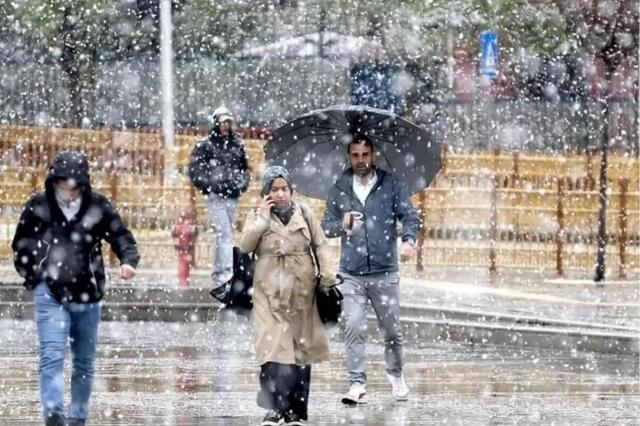
A man sits in Mellat Park in Tehran on 1 December 2025 as the first winter showers soak the Iranian capital after one of the driest years (AFP)
Off
Human costs of UN sanctions
Marking the anniversary of the first UN sanctions against Iran over its nuclear programme, the Ham Mihan daily looked at how years of sanctions have affected everyday life.
The daily recalled how former president Mahmoud Ahmadinejad once dismissed the UN resolutions as “just a piece of paper”. It then laid out data showing a very different reality: rising poverty, falling purchasing power, high inflation, and less food on people’s tables.
According to the report, between 2006 and 2021, the number of people living below the poverty line rose from 9 million to 25.5 million. By 2021, the number of people living in marginalised areas or informal settlements had reached more than 14 million.
The report also pointed to shrinking purchasing power, with meat and dairy disappearing from the diets of low-income families. It noted a rise in school dropouts.
Farzaneh Tehrani, the report’s author, wrote that Iran’s economic decline has continued beyond 2021. “The Iran of 2025 is not the Iran of 2006,” she wrote. “The people of today are no longer the people they once were.”
She described how daily life has changed over these years: “People have lived with inflation of around 50 percent. Many more have fallen below the poverty line. They pay more for housing but live in smaller homes, often in poorer areas, or have moved to cheaper cities and the outskirts. They spend a larger share of their income on food, yet they eat less.”
Iran and Belarus expand military ties
Following a visit to Belarus by Iranian Foreign Minister Abbas Araghchi last week, Iranian state media reported that Tehran and Minsk have expanded their cooperation to include the military sphere.

Iran’s official news agency, IRNA, said the two countries have strengthened military relations alongside their existing economic and political ties. The agency did not provide details on the scope or form of this cooperation.
The Hamshahri daily also described military issues as one of the main focuses of Araghchi’s visit. Iran and Belarus are both close allies of Russia, a point highlighted in the coverage.
According to Hamshahri, Araghchi held talks with senior Belarusian officials, shortly after Minsk had hosted a special Iranian delegation. The newspaper said a military delegation travelled to Minsk to expand defence and military cooperation between the two countries.
Although no official details have been released about the nature of the military cooperation, unofficial reports suggest that Belarus is interested in acquiring Iranian technology for the production of low-cost Shahed military drones.
Military reshuffle after June war
Recent changes in the leadership of Iran’s air defence system have fuelled speculation about a new defence strategy and efforts to create a more unified command structure.
After the US and Israel attacked Iran during a 12-day war in June, Iran’s air defences came under sharp criticism for failing to stop enemy aircraft and drones. In the early hours of the Israeli attack, several senior military commanders and Iranian nuclear scientists were killed.

Against this backdrop, the appointment of Brigadier General Alireza Elhami to lead both the Khatam al-Anbiya Joint Air Defence Headquarters and the Army Air Defence Force, announced last week, is widely seen as a step to better prepare for possible future Israeli attacks.
Jafar Yousefi, a journalist close to conservative circles, described the move as an effort to improve coordination among Iran’s defence forces. Iran’s military structure includes parallel institutions, mainly the regular army and the Islamic Revolutionary Guard Corps (IRGC).
Yousefi said placing Elhami in charge of both centres signals a move for closer cooperation between these bodies. “Giving one commander authority over the Joint Air Defence Headquarters and the Army Air Defence Force shows a clear priority: unity of command during times of crisis,” he wrote.
He added that this change comes amid reports of possible upgrades to Iran’s air defences, including foreign technical cooperation with countries such as China and Russia.
Nuclear scientist inaugurates AI centre
Mahmoud Reza Aghamiri, a senior figure in the country’s nuclear programme, inaugurated Iran’s first national artificial intelligence centre at Shahid Beheshti University in Tehran.
Local media reported that the centre’s name, Shahid (martyr) Feqhhi Centre for Artificial Intelligence and Data Science, also refers to Iran’s nuclear programme.

The centre is named after Amir Hossein Feqhhi, an Iranian nuclear scientist who was killed in the early hours of Israel’s 13 June attack on Iran. At the time, Israel said the strikes aimed to destroy Iran’s nuclear programme.
It is not yet clear which areas of artificial intelligence the centre will focus on. However, its launch by nuclear scientists and its name may point to Tehran’s efforts to expand the use of AI within its nuclear programme.
Mehr News Agency quoted one of the centre’s officials as saying: “The centre was created to carry out specialised AI projects and to link academic research with the country’s practical needs.”
Mehr added that over the next year, five more specialised AI centres will be set up at universities across Iran, forming a national network focused on artificial intelligence and data science.
*Iranian press review is a digest of news reports not independently verified as accurate by Middle East Eye.
Post Date Override
0
Update Date
Update Date Override
0