
 میدل ایست آی
US-Iran tensions: Will Trump flinch at the last moment?
US-Iran tensions: Will Trump flinch at the last moment?
The erratic leader is being propelled into a full-blown war that neither Washington nor Israel will have any capacity to control

US President Donald Trump speaks at the White House on 23 February 2026 (Saul Loeb/AFP)
Off
There is a chilling but uncanny resemblance in the way that US President Donald Trump is preparing to attack Iran, and the way that Russian President Vladimir Putin prepared to invade Ukraine.
Each leader approached the prospect of war emboldened by a military campaign they hailed as a stunning success. For Putin, it was his campaign in Syria. For Trump, it was toppling Nicolas Maduro in Venezuela.
Both men have cut themselves off from reality by surrounding themselves with rings of sycophants.
Putin has gathered around him strategists and theologians, each vying with the other to be more hardline.
One advocated the use of a tactical nuclear device in Ukraine. Another suggested that detonating a nuclear torpedo off the coast of Lancashire and sending a radioactive tsunami over Britain’s aircraft manufacturing industry would be a good idea.
All viewed Ukraine as a proxy battlefield for a broader war with the US and Europe. Putin posed as the veteran holding them back.
Trump, meanwhile, thinks that a defeated Iran will unlock a new Middle East. The equivalent of this circus of sycophants around Trump is Fox News, from where he has drawn Pete Hegseth, his secretary of war.
In both Russia and the US, the power to launch a devastating war begins and ends in the heads of their presidents. In Trump’s case, this is something to boast about: “I am the one that makes the decision,” Trump said on Monday. “I would rather have a deal than not, but if we don’t make a deal, it will be a very bad day for that country.”
Striking range
Both leaders are free from any functioning system of checks and balances - unlike in the days of the Cold War, when wars were collective and calculated decisions. They still proved to be disastrous.
Putin thought - and Trump still thinks - that war would be quick and painless, viewing their targets as low-hanging fruit ripe to pick. Neither man was, nor is, prepared for a long war.
Putin was so confident that Ukraine’s government would collapse like a pack of cards, but his troops quickly ran out of fuel, food and things as basic as a change of socks. The result was that the columns of Russian tanks and troops faced enormous logistical challenges from day one of the invasion, and soon got bogged down.
Trump has started to use the language of former US President George W Bush in searching for an excuse to attack Iran
In the case of Iran, Trump has sent an aircraft carrier into striking range with few working toilets and a crew that has already been on deployment for eight months and is showing obvious signs of stress.
When the Ukraine invasion turned into a fiasco, Putin fired 150 agents from the Federal Security Bureau and sent a senior intelligence chief to prison; failure is never his own. Trump has the same tendency to blame everyone but himself for his catastrophic decisions.
Putin installed a long white table between himself and his war cabinet when Covid-19 was raging through Russia, and Trump has built an equivalent structure in his White House against the ingress of any germ of doubt.
When General Dan Caine, the chairman of the Joint Chiefs of Staff, recently briefed Trump and other senior advisers in the White House, he had three main talking points that jarred with the narrative the president was trying to construct.
Caine said that US forces amassed in the Middle East could sustain a “small or medium” strike, but not a long war; that there would be a potentially high risk of American casualties; and that they would use so many missiles so quickly that the action could deplete US weapons stockpiles, according to The New York Times.
In Trump’s rendering of the same briefing, Caine told him that any military action ordered would be “something easily won”.
Signs all around
But Caine’s doubts notwithstanding, a war is surely coming. This time, no one has to read tea leaves. The signs of an upcoming war are all around, in bright neon lights, wherever you happen to be in the Middle East.
Jordan’s skies are buzzing with intense US military activity. US troops redeployed from Iraq are appearing at a base in Lebanon, which Iranian media is telling the locals they know all about.
Eleven F-22 Raptors have landed at Ovda Air base in Israel’s Negev desert. They flew from RAF Lakenheath in the UK, supported by seven aerial refuelling tankers.
Note this is after the UK government put it around that Prime Minister Keir Starmer had refused permission for British air bases to be used as a launchpad for an attack on Iran. Weasel words.

Israel’s opposition leader, Yair Lapid, told the Knesset that all political differences with Prime Minister Benjamin Netanyahu would be “put into deep freeze” in case of war with Iran.
“As in the past, I will mobilise for Israeli public diplomacy and strengthening Israel’s international status,” Lapid said. “As in the previous attack, I will go wherever necessary, from CNN to the British parliament, and tell them: ‘You know that I am the head of the opposition, you know that Netanyahu and I are rivals, but Iran must be attacked with full force, the rule of the ayatollahs must be overthrown.’”
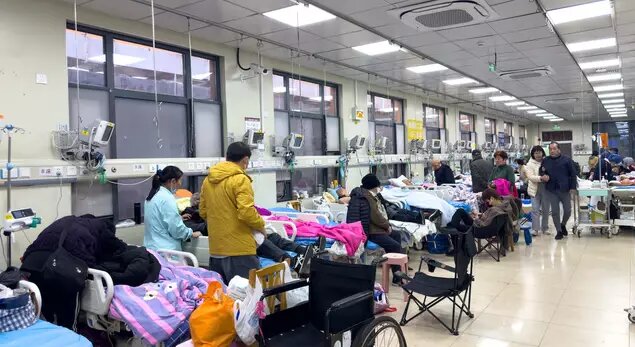
Hospitals in Israel are preparing for war. They are repurposing underground car parks for acute wards.
And last but not least, Trump has started to use the language of former US President George W Bush in searching for an excuse to attack Iran. Bush justified the 2003 Iraq invasion by maintaining that the US was in imminent danger of Saddam Hussein’s weapons of mass destruction (WMD), which proved to be nonsense.
In his latest State of the Union speech - which, like Putin’s two-hour news conferences, broke the record for length - Trump said that Iran was “working to build missiles that will soon reach the United States of America”.
Hours before that speech, his special envoy, Steve Witkoff, claimed that Iran was on the cusp of being able to generate bomb-making material. “They’re probably a week away from having industrial-grade bomb-making material,” Witkoff said on the Fox News programme, “My View with Lara Trump.”
Like Bush’s bogus claims about Saddam’s WMD, each exaggerated assertion is designed to show that the threat from Iran’s nuclear programme is imminent.
Cold calculations
Not unnaturally, Trump’s decision-making process has been the subject of acute study in Iran itself. The country is faced with a man who, after all this time in office, still acts and thinks like a real estate dealer in Manhattan.
He is impulsive, erratic and emotional, but he is armed with stealth Raptors and cruise missiles.
The cold calculations are done by Witkoff, Trump’s son-in-law Jared Kushner, and Vice President JD Vance. Witkoff, Kushner and Vance have a habit of melting into the background when a decision is taken, as we have seen throughout the faltering attempts to secure a ceasefire in Gaza.
And as we also witnessed last June, Trump is quite capable of pressing the “go” button while negotiations are still underway.
With such a huge buildup of naval and air power, Trump has left himself with no off-ramp, other than claiming an unprecedented Iranian concession
Worryingly for anyone trying to second-guess him, Trump is erratic. This has become enshrined in the “Taco” theory: Trump Always Chickens Out.
Aaron David Miller, a former US-Middle East peace negotiator, has a variant of the Taco theory that still has Trump going to war. It is that he has boxed himself into a war he does not want.
“He has put himself in a situation where unless he manages to extract a considerable concession from the Iranians to avoid a war he doesn’t want, he’s going to be forced into one,” Miller told The Financial Times. “This is a crisis of his own making.”
Trump’s language on Iran today has changed from the sharp rebuke he gave Netanyahu for continuing to strike Iran after the US president had called for a ceasefire following the 12-day conflict last June.
Netanyahu - who, unlike Trump, has a clear vision of what he wants an attack on Iran to achieve - has obviously been working on the US president with “intelligence” about how Iran has restarted its nuclear enrichment programme.
With such a huge buildup of naval and air power, Trump has left himself with no off-ramp, other than claiming an unprecedented Iranian concession at the talks taking place in Geneva and Oman.
Preparations in Tehran
Unlike Bush, Trump has not prepared the ground for a war at home or abroad. His excuses for the naval and air buildup have veered wildly from a vow to protesters that “help is on its way”, to ending a nuclear programme that he claimed last year to have obliterated, and lastly to a bizarre claim that Iran’s missiles could be a global threat.
There is no vote in the United Nations Security Council, and his allies in the Middle East have refused to allow US bases on their territory to be used as launchpads.
In contrast, Iran is prepared for a long war - or at least to withstand the first and second shockwaves with command and control intact. Supreme Leader Ayatollah Ali Khamenei has entrusted Iran’s top national security official, Ali Larijani, with the survival of the country in the event of the assassination of Iran’s top leaders. Every senior military and government official has four replacements.
Larijani is an interesting choice as Iran’s wartime leader. A former parliamentary speaker, Larijani showed steadfast support for the country’s former reformist president, Hassan Rouhani. As such, he was disqualified from running in two presidential races by the Guardian Council, which cited insufficient executive experience.
Larijani was also a strong supporter of the 2015 nuclear deal, which invited opposition from the principlists who argued then, and as it turned out rightly, that Iran would get nothing for the compromises it made.
But as a former member of the Revolutionary Guard Corps, Larijani has considerable executive security experience. He was secretary of the National Security Council, one of Iran’s most critical security posts, from 2005 to 2007. Larijani is Iran’s war leader.
Grim determination
Trump has asked why Iran has not capitulated in the face of the vast armada gathered within striking range of its borders. The answer is simple: this is a generation of Iranian leaders who have been honed by war. They have bitter, sometimes personal memories of the gas attacks launched by Saddam in the eight-year Iran-Iraq War.
An estimated one million Iranians, both military and civilian, were exposed to chemical warfare agents. More than 100,000 were documented to have received emergency medical treatment for chemical injuries.
Saddam was at the time financed by Saudi Arabia and Kuwait, and supported by the US and Europe. German firms sent more than 1,000 tons of precursors of mustard gas, sarin, tabun and tear gas, enabling Iraq to manufacture the gases.

Iran has also prepared the ground in the Gulf. It has informed its neighbours that each US base in their countries will become a legitimate target for Iran in the event of war.
If Iran’s main oil terminal at Kharg Island is struck in a US-Israeli attack, all refineries along the Gulf will be vulnerable. To prepare for war, Iran has been loading almost three times the amount of oil it usually does onto tankers.
There is now a grim determination to prepare for war, shared by the two main political factions of Iran’s elite.
Iran faces two crises: an external one and an internal one, after the killings of thousands of protesters in the January uprising. Tens of thousands more have been arrested. But this leadership is not about to fold.
That much is known - but the great unknown is how China may react.
As Nelson Wong argues in these pages, China is unlikely to dispatch troops or engage in any direct conflict. It is saving a direct confrontation with the US for Taiwan.
But, Wong goes on to argue, “to interpret this as passivity would be to misread the nature of 21st-century great power competition”.
Red line drawn
China’s support for Iran is real. Iran is a full member of the Shanghai Cooperation Organisation, which is not a security pact, but China, Russia and Iran recently deployed naval vessels for joint security exercises in the Strait of Hormuz.
Less visible has been the recent arrival of Chinese-made surface-to-air missile batteries in Iran, as part of an oil-for-weapons deal to bypass US sanctions. There are also unverified reports that Iran might have received fifth-generation J-20 stealth fighter jets.
And during Iran’s Air Force Day this month, a Chinese military attache presented a model of the J-20 stealth fighter to an Iranian air force commander. These are public gestures that serve as warnings, too.
This could be the war that proves to be the nemesis of both Trump and Netanyahu, the ultimate bridge too far
What can be said with some certainty is that China has clearly drawn a red line against allowing regime change in Iran, which remains China’s top energy partner.
This, then, has all the makings of a real regional war, which so many other commentators and I have been warning about ever since Israel started its onslaught on Gaza, the West Bank and Lebanon.
Fuelled by his own ego and a sense that things are going wrong for him domestically, Trump is being propelled into a full-blown war that neither he, nor his forces, nor Israel has any capacity to control.
The two powers will be attacking a country four times larger than Iraq, which Bush attacked. The US under Trump is even less prepared than Bush was for the consequences of a prolonged war.
Will Trump flinch at the last moment? Who knows. If he has any vestige of common sense, he should - for this could be the war that proves to be the nemesis of both Trump and Netanyahu, the ultimate bridge too far.
The views expressed in this article belong to the author and do not necessarily reflect the editorial policy of Middle East Eye.
Post Date Override
0
Update Date
Update Date Override
0