Why did nearly 60,000 migrants suddenly storm the border into Spain?
A court ruling, Moroccan pressure and tensions with Washington have all been cited as possible triggers for the Ceuta crisis
Up to 60,000 migrants crossed from Morocco into Spain’s North African enclave of Ceuta in roughly 24 hours, overwhelming border forces and increasing the territory’s population by as much as 70%.
The unprecedented influx has triggered a political crisis, raised questions over the true nature of the incident, and exposed deep divisions in the West.
What happened at the border?
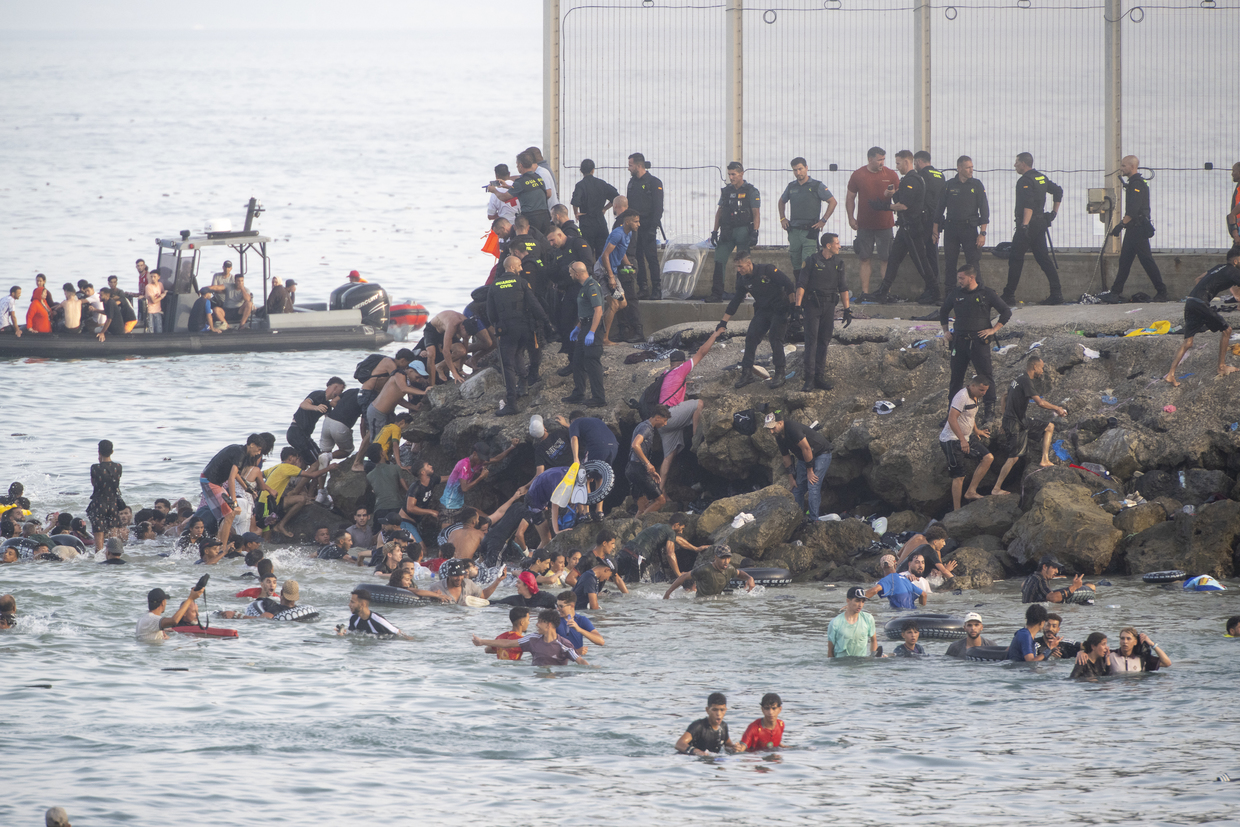
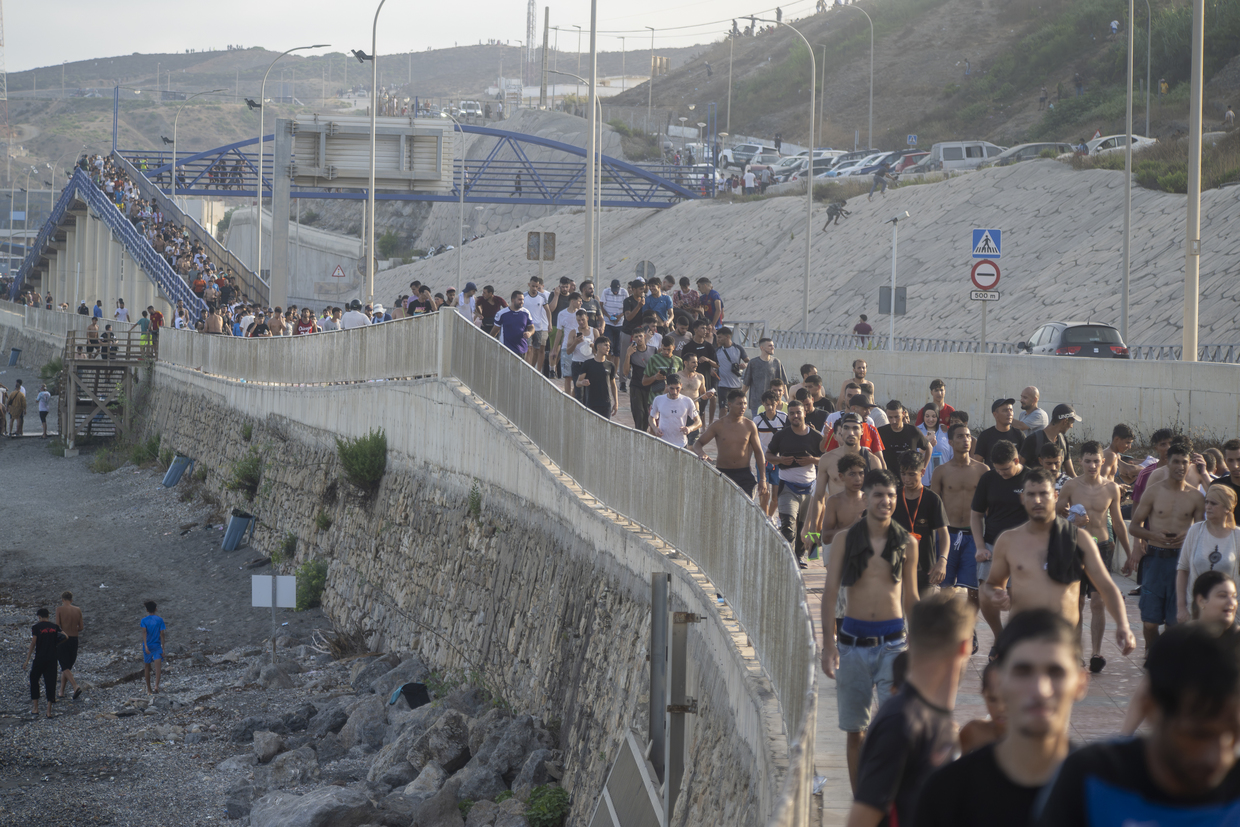
Tens of thousands of migrants stormed a weak point in the town of Cueta, on the Spanish border with Morocco on Thursday. Ceuta’s regional president, Juan Jesus Vivas, said on Friday that around 60,000 people had entered the city since the border crisis erupted the previous day. The magnitude is such that it represents the single greatest human traffic invasion in the EU’s history.
Even more conservative estimates from Spanish media and security sources ranging from 30,000 to 49,000 would still mean that Cueta’s regular population of some 84,000 had increased overnight by some 50%.
At least 41 migrants reportedly died. Many drowned while attempting to swim around the border barriers, while others were allegedly killed in a stampede near the Tarajal breakwater.
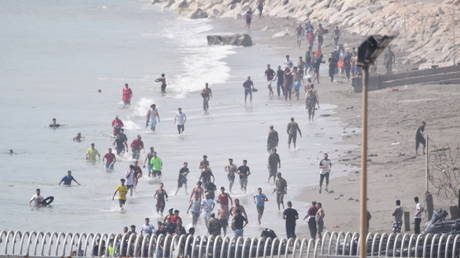
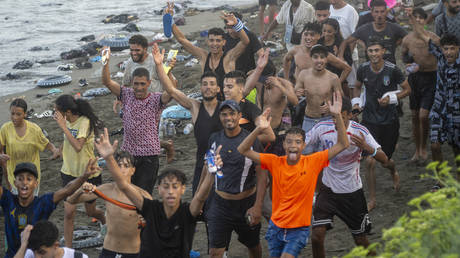
Widely circulated footage showed predominantly young adult men swimming around the breakwater, climbing border structures, and pouring through crossing points as Spanish officers struggled to contain them. Some later marched through Ceuta chanting: “Bye bye Morocco, hello Spain.”
Local police said they had been “completely overwhelmed” by the influx, while the regional government warned that reception facilities, hospitals, and other public services were nearing collapse.
So sieht das dann aus, wenn Tausende Marokkaner in #Ceuta nach Spanien übersetzen. Das ist eine Landnahme und sie treffen auf ein sozialistisch regiertes Land, das gerade erst 1,2 Millionen illegale Migranten mit legalen Papieren ausgestattet hat und einen Regierungschef, der… pic.twitter.com/2Utuz8gJoW
Madrid initially rejected Ceuta’s request to declare a national emergency but later deployed soldiers, special police, and additional Civil Guard units.
Morocco eventually reinforced its side of the border, deployed water cannons and tear gas, fired warning shots, and moved detained migrants away from the frontier. By Friday afternoon, the massive flow appeared to have largely stopped, although some people continued trying to swim into Spanish territory.
Hundreds of migrants also began walking back toward Morocco through the same breakwater route they had used to enter Spain.
Why Ceuta?
Ceuta is one of two Spanish territories on Morocco’s northern coast, alongside the enclave of Melilla. Together, they form the EU’s only land borders with Africa. Morocco claims both cities as part of its territory, viewing continued Spanish control as a legacy of European colonialism, while Madrid has considered them integral parts of Spain since 1580.
The enclaves have repeatedly become flashpoints in diplomatic rows between the two countries. Morocco is believed to have intentionally eased border controls during a dispute in 2021 to spark a migrant influx to pressure Madrid. However, that incident involved only about 10,000 migrants - several times less than the latest crisis.
What triggered the crisis?
It is currently unclear what exactly sparked Thursday’s incident but several possibilities have been raised. Spanish officials blame traffickers exploiting a recent court ruling, others suspect that Morocco deliberately eased border controls to pressure Madrid.
Some have also linked the timing to Spain’s rapprochement with Algeria, Morocco’s regional rival, and to the Sanchez government’s worsening relations with Washington.
🚨 BREAKING UPDATE: Spain's Civil Guard chief declares the border has "TOTALLY COLLAPSED," per @BillMelugin_
THOUSANDS of military-aged African men have poured over the border in the past several hours.
How did the Spanish court ruling increase the risk of mass migrant invasion?
The Supreme Court ruling in July asserted that immediate deportation can only apply to migrants crossing land barriers. Those intercepted at sea, on the other hand, must instead go through standard deportation procedures, including legal assistance and the chance to claim asylum.
The Spanish government has claimed that this ruling was misrepresented by traffickers as making sea crossings harder to reverse. The idea had allegedly spread “like wildfire” through human-smuggling networks and helped trigger the mass rush, Madrid suggested.
Critics have also linked the influx to Spain’s recent regularization of around 500,000 undocumented migrants, arguing that the measure encouraged further illegal entry.
Is Morocco applying pressure on Madrid?
The scale of the influx and the apparent lack of resistance on the Moroccan side have prompted accusations that Rabat deliberately loosened border controls to pressure Madrid, drawing parallels with the 2021 incident.
Tens of thousands of people were able to travel toward Ceuta and gather near the frontier before Moroccan forces intervened. Civil Guard sources described Rabat’s initial assistance as limited and insufficient, while footage showed migrants entering by sea and land as Moroccan security forces largely remained out of view.
Morocco, however, has vehemently denied its involvement in the latest influx, instead blaming criminal trafficking networks for the crisis.
Spanish Prime Minister Pedro Sanchez has also maintained that cooperation with Morocco continues.
The Algeria dispute
Suspicions of Morocco’s involvement have further been fueled by the timing of the crisis, which comes as Spain has been seeking to restore relations with Algeria - Rabat’s main geopolitical rival.
The two North African states have long been at odds over Western Sahara. Morocco claims the territory as its own, while Algeria supports the Polisario Front’s demand for an independent Sahrawi state.
Spain had backed Morocco’s autonomy plan in 2022 and repaired ties with Rabat. However, that caused a diplomatic rupture with Algeria, an important energy supplier to Spain.
Last week, Sanchez visited Algiers for the first time in four years as the two governments seek to restore relations. The Ceuta crisis erupted ten days later.
Some have suggested that Morocco intentionally allowed the migrant influx to occur as retaliation for renewed Spanish engagement with Algeria and an effort to influence Madrid’s foreign policy. Morocco has rejected the accusations.
Is Washington part of the equation?
Some have also linked the crisis to tensions between Washington and the Sanchez government, which escalated after Madrid refused to allow its bases to be used for US strikes on Iran.
US President Donald Trump has repeatedly criticized Madrid for refusing to commit 5% of GDP to defense and has threatened to cut trade off with Spain altogether..
Following the Ceuta breach, senior White House officials shared footage of the crossings, presenting the crisis as the result of Spain’s left-wing migration policies and directly targeting the Sanchez government.
The United States stands with the people of Spain, and all Europeans, against this egregious violation of their sovereignty and human rights.
This unacceptable incident is the direct result of the Spanish Government's deliberate efforts to enable and facilitate mass illegal…
Washington has meanwhile maintained close relations with Rabat, reaffirmed its recognition of Moroccan sovereignty over Western Sahara, and praised Morocco’s role in the US-backed Abraham Accords with Israel.
This has prompted claims that Morocco may have expected the Trump administration to tolerate political pressure on Sanchez, particularly when the crisis also served Washington’s own campaign against the Spanish government.
How has the international community reacted to the mass immigrant invasion?
The images of dense crowds streaming into Ceuta have prompted shock and ridicule that Spain has lost control of its border.
US President Donald Trump called the scenes “terrible” and presented them as a warning of what could happen in the US if Democrats returned to power.
European People’s Party leader Manfred Weber described the situation as “appalling” and said that the images were the direct consequence of the “pull factor” created by Spain’s mass regularization program and the “instrumentalisation of illegal migration.”
Italy accused Spain of failing to protect the EU’s external frontier and encouraging further migration through its regularization policy. Prime Minister Giorgia Meloni said Rome was prepared to consider “extraordinary measures,” including suspending Schengen arrangements with Spain. Finland has backed the proposal.
Elon Musk mocked the scenes by comparing them to the zombie film World War Z with the caption: “Wow, the situation in Spain looks crazy!”
Russian presidential investment envoy Kirill Dmitriev compared the crowds with depictions of the sack of Rome in 410 AD and described Ceuta as a vivid illustration of “catastrophic” EU and UK migration policies. He also accused European left-wing parties of supporting mass immigration in the expectation that migrants and their descendants would later vote for them.
Other widely shared posts have also ridiculed the Sanchez government’s longstanding humanitarian defense of migration by contrasting his rhetoric about empathy and vulnerable newcomers with footage from Ceuta showing crowds composed overwhelmingly of young men.
Can the migrants be returned?
Spain and Morocco have agreed to accelerate the return of those who entered Ceuta illegally, but Madrid cannot summarily send back migrants who arrived by sea.
Under the recent Supreme Court ruling, the expedited “border rejection” procedure applies only to people crossing physical barriers, such as fences. Those intercepted after swimming into Ceuta must instead be dealt with under the ordinary return procedure, which requires individual processing, legal assistance, and access to asylum protections.
Unaccompanied minors also cannot be deported as adults and must be identified and placed under child-protection procedures.
According to Spain’s Interior Ministry, around 37,500 of the estimated 60,000 arrivals had already voluntarily returned to Morocco by Friday afternoon. Spanish authorities have not said how many of those remaining will be deported or how long the process could take. The government is reportedly considering new maritime barriers and possible legal changes to facilitate its response to future crossings.



 آرتی
آرتی